Truss stability
When a truss holds its shape and stays put, and why counting members isn't enough
Last updated 2026-09-25
A truss only works if it stays put: nothing slides, nothing turns, nothing folds. That's what stable means. If a truss can move, no balance equation will give you its forces, because there's nothing to balance: it just moves.
Counting: m + r = 2j
Every joint has to balance sideways and up-down, so each joint gives you two equations. With j joints, that's 2j equations.
The unknowns are the force in each member (m) and each support reaction (r). A pinned support gives two reactions, a roller gives one.
m + r = 2j
- m + r is less than 2j: there aren't enough members or supports. The truss can move, for sure.
- m + r equals 2j: there are exactly enough. The truss is stable, if the members and supports are in the right places.
- m + r is more than 2j: there are more than enough. Balance alone can't find every force, but Truzme still can, because it also works out how much each member stretches.
The count is necessary but not enough: a truss that fails it can always move, but a truss that passes it can still move too. Truzme's stability indicator looks for every one of the cases below.
1. Too few supports
The whole truss moves as one piece. With no supports at all, nothing holds it anywhere. On two rollers, nothing holds it sideways, so it slides away. On a single pin, it can turn around the pin.
A truss needs at least three support reactions. The usual choice is one pinned support and one roller.
2. A joint that isn't held
Every joint has to be held in two directions, by members or supports that don't all lie in one line. If it isn't, the joint can move on its own while the rest of the truss stays put.
- A member sticking out. Its free end is held by that one member only, so it can swing around like a door on its hinge.
- Two members in a straight line. They can hold the joint along their line, but not across it. Nothing stops it from sagging, until the members have bent a long way.
3. A part that doesn't hold its shape
A whole section of the truss can move while the rest stays put. A square panel without a diagonal folds over, the same way a square frame does in What is a truss.
The right-hand truss shows why counting isn't enough. It has exactly the right number of members, but one panel has two diagonals and the other has none. The count only says how many members there are, not where they are.
4. Supports in the wrong place
The count works, every panel is a triangle, and the truss still moves.
- All support reactions meet in one point. On the left, the roller can only push sideways, straight at the pin. Nothing stops the truss from turning around the pin.
- All support reactions point the same way. On the right, three rollers all push straight up. Nothing holds the truss sideways, so it slides.
The first one is easy to miss, especially when the point where the support lines meet is somewhere outside the truss. Truzme shows it clearly: it draws every support's line dashed, and marks the point where they all meet, the point the truss would turn around.
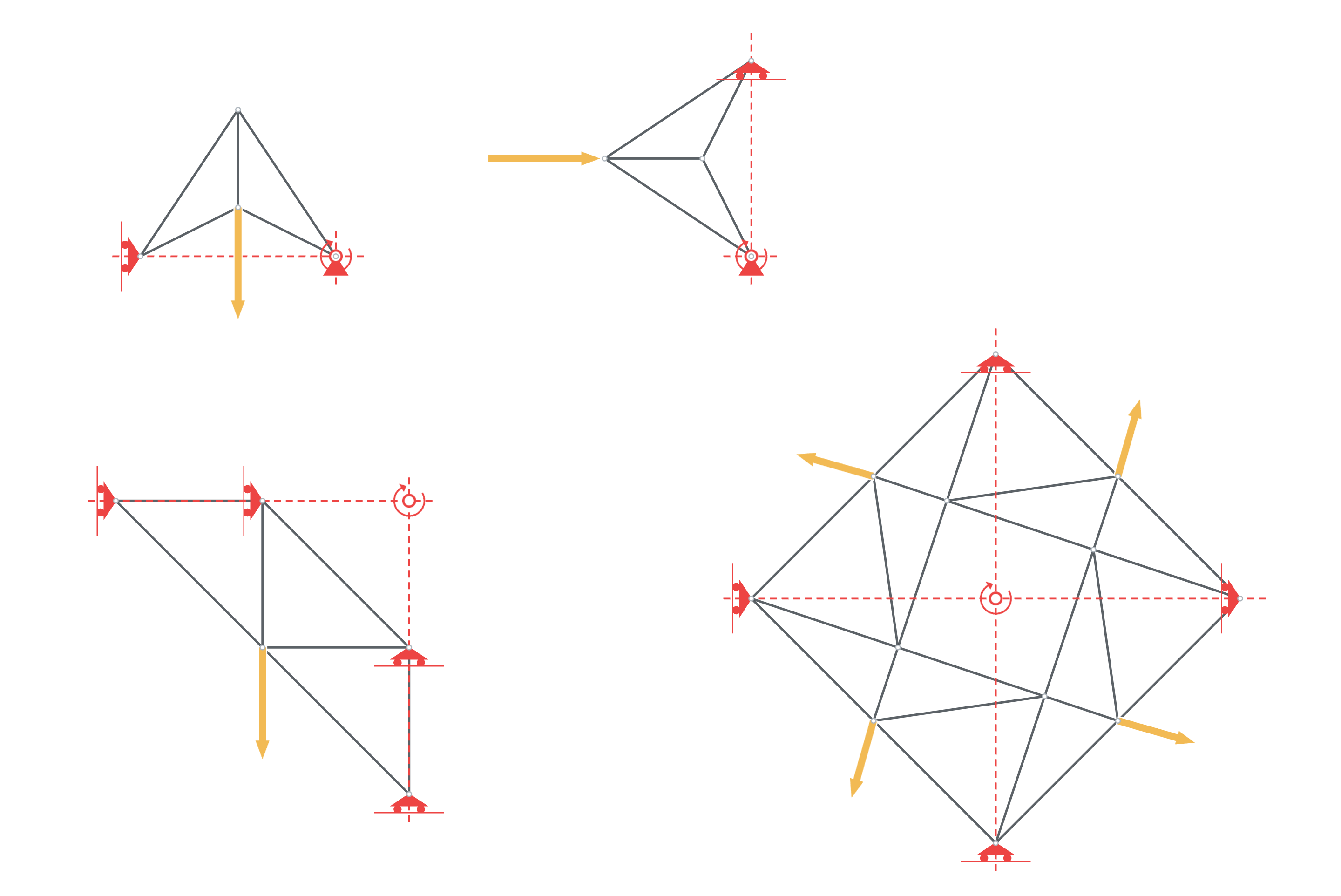
Try it yourself: every truss in this example looks fine at first glance, and every one of them can turn.
Example
Sneaky instability
Enough supports, yet still not stable. Why?
In short
- Count first. If m + r is less than 2j, the truss can move. Add members or supports.
- Check every joint. Each one needs at least two members or supports that aren't in one line.
- Look for parts that can fold. Every panel should be a triangle.
- Look at the supports. Their reactions must not all point the same way, and must not all meet in one point. A pinned support plus a roller that pushes up (not at the pin) always works.
Check it in Truzme
Truzme checks all of this for you: the stability indicator in the toolbar shows whether your truss can move, and if it can, what's wrong. The Stability check guide explains how to read it. This example is full of unstable trusses to try it on:
Example
Unstable trusses
A collection of structures that are all unstable